Rose Buckley: Have Fun, Partner
- At October 22, 2026
- By Jessica
- In Interests
 0
Published in D22 Connection, October 2026
By Jessica Dee Rohm
In case you miss it, this is the third “Rose” to be featured in D22 Connection. Just a coincidence, but to paraphrase Shakespeare in Romeo and Juliet, “A rose by any other name would” play bridge.
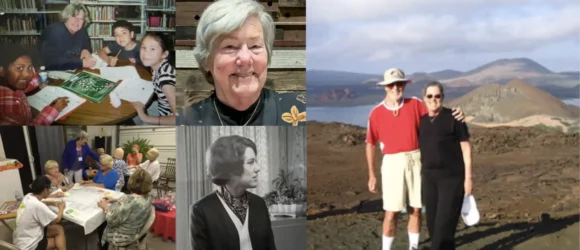
This Rose, Rose Buckley, has spent much of her life solving puzzles. First, they involved mathematics, then computers, and eventually bridge. Along the way she pioneered a career in engineering and technology, raised two children, traveled the world, and taught generations of bridge players. Her philosophy can be summed up in two words: Have fun!
Rose was born in Ventura, CA during what she cheerfully calls “the War Years. Not Iraq, not even Vietnam, but World War II.” Her father served in the Army Air Corps while her mother, a registered nurse, ran a floor at Ventura County Hospital and raised Rose and her older brother.
Her father returned to become a postman and eventually Postmaster of Ventura. Rose stayed in her hometown until she “ventura-ed out into the world,” entering Cal Poly San Luis Obispo’s Aeronautical Engineering program, the only woman among several hundred men. Marriage followed, along with a switch to mathematics. She became the first woman surveyor in California’s Division of Highways.
In the mid-1960s, Rose discovered the field that would fascinate her for 35 years: computers. “I couldn’t believe people would actually pay me to solve puzzles!” She passed an aptitude test and launched herself into the new industry.
Rose eventually moved to Los Angeles, consulted for Jet Propulsion Laboratory and spent 15 years with Kaiser developing early online systems for admissions, clinics, pharmacies, and membership. One project became personal: she helped analyze data on RhoGAM, a drug being studied to prevent Rh-negative mothers from developing antibodies against their Rh-positive babies’ blood. Later, she received RhoGAM herself, helping protect her own baby.
The Cards Were Always There
Before television, a deck of cards was family entertainment. Rose’s grandfathers occasionally permitted her and her brother to join their Cribbage games with one proviso: no giggling. Go Fish taught suits, Concentration taught memory and Cribbage taught arithmetic. By her teens, Rose played kitchen bridge because her parents were forever looking for a fourth.
During the “Golden Years” in Silicon Valley, from 1995 to 2000, she discovered duplicate bridge. Retired by then, she found day trading decidedly less interesting. She went to Vancouver for her first tournament, found a pick-up partner, did well, and was hooked.
Bridge came roaring back in 2013 when a Ventura women’s club asked her to teach. There was one small problem: Rose was a Jr. Club Master with all of five masterpoints. Unable to say no, she did what any good mathematician and computer programmer would do: she stayed one lesson ahead of her students.
There was another surprise. Bridge had changed. No more Goren. Now there were five-card majors and Standard American. Armed with Audrey Grant’s books, Rose adopted a “play as you learn” approach for her students and, occasionally, herself. She loved teaching, returned seriously to the Ventura bridge club and taught beginners for ten years, including Zoom classes during COVID.
Meanwhile, Rose had her own goal: Life Master. Three hundred masterpoints, the requirement at the time, seemed nearly impossible. Her husband disagreed.
“You can do it,” he said. “You just need to find a decent partner.”
So, she did.
Rose became a Silver Life Master and is now aiming for Gold and 2,500 masterpoints.
“One thing bridge gives us,” she says, “is always another ‘unachievable’ goal.”
When Rose returned to the Ventura Unit Bridge Club, people went out of their way to find her partners. She decided to pay that kindness forward. Before she knew it, she was board Secretary, then President for two two-year terms. When the club manager, who directed all the games, died unexpectedly, Rose found herself teaching, directing and serving as hospitality chair for three sectionals a year.
Then COVID threatened face-to-face bridge. Rose and her board established online games, met on Zoom and trained virtual-game directors. With no rent during the shutdown, the club emerged financially healthy enough to reopen. Today she remains its webmaster and substitutes as a teacher. For ten years, she also tutored children through Project Understanding, helping with homework and practicing Spanish with their parents. “It was a beautiful time in my life,” she says. “I got back way more than I gave.”
Finding Happiness
In the 1980s, unhappy with Los Angeles, Rose started her own company, sold her house, stored her furniture and took her children to Europe for six months. She went looking for happiness.
“Happiness wasn’t a place,” she realized. “It was a state of mind.” What endured were friends and family. She returned to Ventura and found what she wanted under her nose.
Rose has been married to Kurt, her third husband, “three times is the charm,” for 35 years. A retired Army lieutenant colonel with a Ph.D. in heat transfer, he discovered a passion for walking, completing the Camino de Santiago at least five times.
“And,” Rose adds, “he’s a very nice guy.”
In their early 60s, they spent about five years traveling almost nonstop, exploring China, Russia, the Galápagos, and beyond. Tanzania’s Great Migration remains “the most amazing trip of our lifetimes.” Rose edited their adventures into home movies, with Kurt providing research and voice-overs in his soothing “radio voice.” One rule: no film could exceed 30 minutes. Even Rose understood that friendship has its limits.
Some treasured memories are quieter. As a single mother working 60-hour weeks, time with Sean and Deborah was precious. Debby is now a favorite tournament partner. Sean helped create animated PowerPoint presentations for Rose’s Zoom lessons.
After years of playing, teaching and directing, Rose’s bridge wisdom is simple: partnership matters. She has watched players berate partners after a bad board, only to see both partnership and score deteriorate. Winning bridge, she teaches, requires six important words.
“Thank you, partner.” Say it when dummy comes down—even when you are thinking: Where’s the hand you bid on? Then, after the hand: “Nicely played, partner.”
Both require a genuine smile even when you privately suspect a chicken could have played better.
Ask Rose how to improve bridge and she finally encounters a problem she doesn’t think needs solving.
“No idea,” she says. “It’s perfect as it is.”
Perhaps Rose long ago discovered that the important thing isn’t simply solving the puzzle. It’s enjoying yourself while you’re doing it.
Her advice?
Have fun! ♣