Dennis Williams: From Tenor for the Metropolitan Opera to Ten+ Point Hands at the Bridge Table
- At September 15, 2026
- By Jessica
- In Interests
 0
0
Published in D22 Connection, September 2026
By Jessica Dee Rohm
Admit it….you’ve always wondered what opera and bridge have in common. Well, humorist Robert Benchley once quipped, “Opera is when a guy gets stabbed in the back and, instead of bleeding, he sings.”
Kind of like bridge, no?
You never quite know whom you are going to meet across a bridge table. That’s part of the fun. The mild-mannered gentleman or mysterious lady studying his or her cards may be a retired surgeon, a rocket scientist, a former CEO or, in the case of Dennis Williams, a man who spent 25 years singing on one of the most famous opera stages in the world.
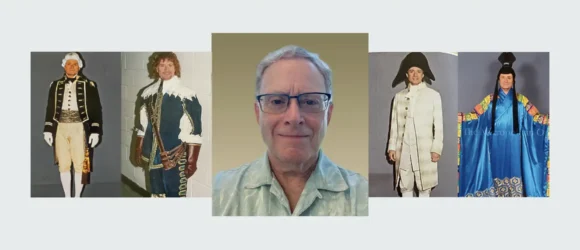
Dennis Williams, a regular at Redwood Bridge Club in San Diego’s Balboa Park, was a tenor with the Metropolitan Opera in New York City from 1986 until 2011, a quarter century during which he performed in hundreds of productions and shared the stage with many of the greatest opera singers of his generation.
Not bad for the fellow who may now be sitting across from you contemplating whether to finesse the queen on the right rather than sing to the Queen of the Night.
Dennis was a member of the Met’s full-time chorus, which is rather like saying someone played baseball for the Yankees without mentioning that he had to be awfully good at baseball to get there. This analogy is apropos as Dennis loves baseball and gardening almost as much as playing bridge.
Dennis also sang over 100 solo roles including Giuseppe in La Traviata and Parpignol in La Boheme. That’s one hundred solos, the opera equivalent of 100 home runs.
The Metropolitan Opera is one of the most prestigious opera companies in the world, and its chorus is made up of highly trained professional singers who must not only possess exceptional voices but also master an enormous and constantly changing repertoire.
During his years at the Met, Dennis sang in six languages and performed everything from the standard repertoire to less familiar works. Among the hundreds of performances in which he appeared were Verdi’s La Traviata and Puccini’s Turandot, operas whose melodies are familiar even to people who insist they know absolutely nothing about opera. In case you were puzzled by the Queen of the Night reference above, she is one of the most famous characters in Mozart’s most famous opera, The Magic Flute.
And unlike those of us who occasionally have difficulty remembering what was bid two minutes ago, Dennis had to remember music, words, blocking and stage direction, often in a foreign language, with an orchestra playing beneath him and several thousand people watching.
Perhaps bridge isn’t so intimidating after all.
“I always loved to sing. My favorite class in grade school was music when Sister Cecilia played the piano and we sang songs from the music book,” Dennis remembered. “One of my classmates asked ‘why do I have to sing so loud.’ It was then I realized I have a voice.”
Dennis’s musical education began long before he arrived at Lincoln Center. He earned a B.S. in Music Education from West Chester State College in Pennsylvania, followed by a Master of Music in Vocal Performance there. He later attended New York University, completing 30 credits toward a Ph.D. in Music Education.
Before joining the Metropolitan Opera, Dennis built an impressive résumé in New York and Philadelphia. He sang with the Gregg Smith Singers and Sine Nomine Singers in New York, as well as the After Dinner Opera Company. In Pennsylvania, he performed with the Pennsylvania Opera Festival, Pittsburgh Opera, Philadelphia Lyric Opera, and the Philadelphia Oratorio Choir.
Then, in August 1986, he joined the Metropolitan Opera.
For a professional singer, walking into the Met must have been a little like a baseball player walking onto the field at Yankee Stadium for the first time. This was the house of Caruso, Callas, Pavarotti, Leontyne Price, and Placido Domingo. Night after night, Dennis stood on that same stage.
And he stayed there for the next 25 years.
Eventually, however, the curtain came down on Dennis’s New York chapter. He left the Metropolitan Opera in July 2011 and moved to San Diego. Maybe those New York winters got to him.
But singers, apparently, don’t retire their voices quite as easily as the rest of us retire our briefcases.
Since arriving in California, Dennis has continued performing with the San Diego Opera Chorus, Musica Vitale and Genesis Opera Theater. His church work has included singing at Immaculata at the University of San Diego, where he has served as tenor section leader and cantor, and at All Saints Episcopal, where he has been a tenor soloist and section leader. Sister Cecilia would be proud.
Which brings us back to bridge.
There is something rather fitting about an opera singer becoming a bridge player. Both pursuits demand concentration, memory, discipline, timing and the ability to work in perfect harmony with other people. And, the link between math and foreign language ability is well known.
Of course, there is one important difference.
At the Metropolitan Opera, if Dennis made a dramatic gesture and raised his voice, the audience applauded. At the bridge table, director David Walters (from whom Dennis started taking lessons in 2022) might tell him to pipe down. The likelihood of this happening, of course, is next to nil as Dennis is one of the kindest and gentlest souls in the bridge world.
So, the next time you find yourself playing against Dennis Williams, remember that the quiet tenor on the other side of the table spent a quarter century under the lights of the Metropolitan Opera.
And if he happens to make a particularly beautiful bid or make slam, perhaps a discreet “Bravo!” would not be entirely out of order. ♣