Life Shaped by War, Waves, and Wonder
- At October 10, 2025
- By Jessica
- In Interests
 0
0
Published in D22 Connection, October 2025
The Story of Ian Collins
By Jessica Dee Rohm
Born in Birmingham, England, in the shadow of World War II, Ian Collins’ earliest memories were shaped by upheaval. As a child evacuee, he and his sister were shuttled between country homes while his father served in the artillery—surviving Dunkirk, fighting across North Africa, Italy, Cyprus, and France—before being seriously wounded in the battle for the Rhine Bridge. At home, rationing meant Ian was always hungry, though his grandmother’s garden and hens provided rare comforts. Nights often meant huddling in a corrugated steel bunker while bombs fell over Birmingham.
“Even as a boy, I learned to live with uncertainty,” Ian recalls. “You didn’t know if your house would be there in the morning, but somehow life carried on.”
Despite disrupted schooling, resilience became his hallmark. He excelled academically, earning awards in mathematics and music, captaining his school chess team, and dabbling in rugby, cricket, and even boxing. A nearby library nurtured his curiosity, and countless hours among its stacks cemented a love of learning. Winning a scholarship to the University of Birmingham, he chose civil engineering, inspired by both mathematics and hands-on experience at construction sites.
Graduate studies took him to Queen’s University in Ontario, where he became fascinated with harbor siltation, beach erosion, and the science of waves. Summers spent on pier construction and at the Delft Hydraulics Laboratory deepened his expertise, and by the time he graduated, Ian was already an emerging authority on coastal engineering. Along the way, he discovered duplicate bridge, immersing himself in the ACOL system (a British bidding system developed in London in the 1930s) from the ground up
His career spanned continents and decades, fueled by a passion for understanding the power of water. Early projects took him from hydroelectric plants to flood studies in New Orleans after Hurricane Betsy, surf-zone research for the U.S. Navy, and even classified work on underwater nuclear explosions. In Washington, D.C., and later Pasadena, he built a reputation for tackling storm flooding, coastal erosion, and wave impacts on critical infrastructure.
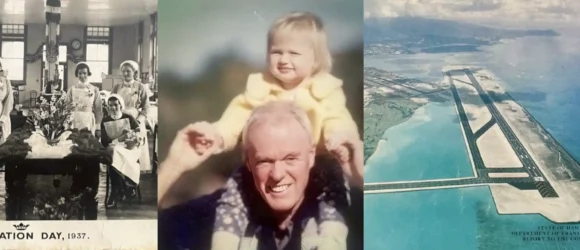
He became part of TetraTech when it was still a fledgling start-up, helping it grow into a global engineering firm. His expertise carried him to projects shaping airports in Honolulu and remote Pacific islands; designing naval bases and LNG terminals in the Middle East; and modeling wave forces for nuclear power plants. Later, at Arctec in Escondido, Ian oversaw towing tanks and wave basins so advanced that Hollywood rented them for blockbuster films like Titanic and True Lies. His work even took him to Beijing, where he negotiated the installation of wave-making technology, celebrating his 50th birthday in the Chinese capital.
“Water is both the most patient and the most relentless force on earth,” Ian says. “My life’s work has been learning how to respect it—and sometimes how to push back.”
Internationally recognized, Ian represented North America on the International Towing Tank Committee, collaborating with leading marine engineers across Europe. Eventually, he co-founded Coastal and Marine Technology, later merged into Scientific Marine Technology and British Maritime Technology. His consulting extended into retirement, supporting ports, oil companies, and universities worldwide.
Yet his life has always been more than engineering. Ian grew up with a close-knit family: one sister, two brothers born after the war, and a youngest brother 17 years his junior—born on the very same date. “I used to joke that I never had a birthday to myself again,” he laughs. His middle brother became a gifted musician, playing violin, guitar, and banjo in a bluegrass band before his untimely passing. His sister went on to lead a hospital’s physical therapy department before retiring, while his youngest brother built a distinguished career with degrees in electrical engineering, law, and an MBA.
Ian is equally proud of his children. His daughter is an oncologist, leading worldwide drug trials for a Coloradobased company and serving on the board of a firm in San Diego. His son, based in Atlanta, followed his passion for art into medical illustration, combining creativity with technology to depict complex surgical procedures and injuries. “He loved art, but medical art pays more!” Ian jokes, noting that his son now heads a team of illustrators while also managing his company’s computer networks.
Through all these chapters—wartime displacement, academic triumphs, global engineering projects, family achievements—Ian’s life reflects resilience, intellect, and a fascination with both human ingenuity and nature’s forces. From bombs falling over Birmingham to wave machines in Beijing, he has lived at the intersection of history and science, hardship and wonder.
Now retired, Ian plays golf three times a week and, in his spare time, pursues his curiosity in subjects such as biochemistry, thermodynamics, geology, and astrophysics. To deepen his understanding, he listens to The Great Courses, a series of lectures by leading science professors.
Looking back, Ian muses: “I was just a boy who loved to read and solve puzzles. The war toughened me, the sea inspired me, and my family grounded me. If I’ve left anything behind, I hope it’s the sense that curiosity and persistence can carry you a very long way.” ♣