Lucky Swarms – Kathleen Owen
- At July 09, 2026
- By Jessica
- In Interests
 0
0
Published in D22 Connection, July 2026
“The bee is such a busy soul, She has no time for birth control.
That is why, in times like these, There are so many sons of bees.”
— Ogden Nash
By all appearances, Kathleen Owen seems perfectly suited to the orderly world of duplicate bridge. A retired insurance executive with a degree in accounting from USC, a CPA examination under her belt, multiple insurance licenses, and a career spent building and running successful companies, she understands systems, probabilities, and managing risk.
Which is perhaps why no one who knows her well is surprised that, during the uncertainty of Covid, Kathleen embraced an entirely new occupation. She became a beekeeper. Or perhaps more accurately, a bee rescuer.
A friend mentioned to Kathleen that she had purchased a beehive as a Father’s Day gift. Once the bees were installed, however, the recipient’s wife decided she preferred life without 50,000 buzzing roommates. Suddenly, the hive needed a new address.
Kathleen lived on a large lot in Rancho Santa Fe and had plenty of room, but she knew absolutely nothing about bees.
Fortunately, one of her neighbors maintained a large apiary and introduced her to Eric Robinson, a scientist by weekday and environmentalist and bee rescuer on weekends. Beekeeping ran in Eric’s family. Both grandfathers had been instrumental in the San Diego Beekeepers Society.
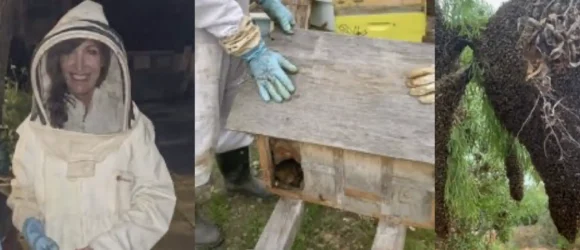
Soon Kathleen found herself dressed in borrowed protective gear, loading the hive into Eric’s car and transporting it to its new home.
That should have been the end of the story. Instead, it was only the beginning.
Before long, Kathleen had volunteered for Eric’s weekend rescue missions. Along with another helper named Dan Lanzer—a retired Navy Laboratory IT specialist and former Navy medic with a gift for ingenious bee-moving contraptions—she spent Saturdays and Sundays removing colonies from irrigation boxes, chicken coops, owl houses, fences, planters, birdhouses, shed floors, walls, attics, and trees so tall they seemed to touch the clouds.
Sometimes the calls took her to homes of people she recognized from the great Scott Farr’s Bridge By Farr bridge classes from before Covid interrupted normal life.
Who knew duplicate bridge and bee extraction occupied such neighboring circles?
Not all bees, Kathleen discovered, possess identical personalities. Some colonies were gentle and cooperative. Others, in Kathleen’s understated description, were “spicy.” Kind of like bridge players, no?
Researchers at UC San Diego estimate that many local feral bees are roughly sixty percent Africanized, making each rescue something of an adventure. Yet even the spicier bees deserved saving.
“My son likes to tease me because every time I walk up to a hive I say, ‘Hello, Ladies.’ When I’m relocating them, I encourage them to move into their new home, and if I accidentally squish one, I apologize. I know it sounds silly, but we’re kindred souls.”
Over time, Kathleen learned to listen to her new friends. “When the girls are happy, the hive has this lovely low hum. If they’re disturbed, the pitch and volume go way up. That’s when you know you need to proceed carefully.”
To manage transport, she and her partners use a few tricks. “We spray sugar water as a snack so they’ll stop and clean themselves, or we use smoke. Both delay the alarm pheromone. That pheromone smells exactly like banana Hawaiian Tropic sunscreen—and when you smell it, things are about to get spicy.”
Kathleen insists that calm matters. “It really helps to stay calm and grounded. And beekeeping with a buddy is always a good idea.”
Word spread through Rancho Santa Fe. Friends, desperate for outdoor activities during the isolation of Covid, became interested in hosting hives. Kathleen happily obliged. Soon she was supervising numerous colonies, while Eric and Dan oversaw others.
Then Spring brought honey season. After removing the honey ‘supers’ the upper boxes where the queen is forbidden to enter—the trio gathered for the sticky work of spinning honey. The result was gallons of raw, golden sweetness.
Some went to homeowners who hosted the hives. Much of the rest found its way into Mason jars and eventually supported Trojan League scholarships for San Diego students attending USC. Trojan League has awarded millions of dollars in scholarships over the past fifty years, making Kathleen’s bees surprisingly productive philanthropists.
As Covid alarm faded and life returned to normal, Kathleen reduced the number of hives under her care. Today she maintains only a few colonies, though her enthusiasm remains undiminished.
And what enthusiasm! She delights in sharing bee trivia. Such as:
- All worker bees are female.
- Throughout their six-week summer lives, they change careers several times. Some become nurses tending brood. Others are water collectors, water receivers, undertakers, guards, scouts, or foragers. The queen, meanwhile, may reign for two or three years.
- A healthy summer colony contains around 50,000 bees, all focused on one goal—survival.
- When the hive becomes crowded, they swarm.
Should you find yourself in the middle of one of these airborne migrations, Kathleen offers a curious piece of advice. Don’t panic. But hold your breath.
Guard bees instinctively target carbon dioxide, which evolved as a defense against predators such as bears and badgers. Fortunately, swarming bees are generally docile. Before leaving home, they gorge themselves on honey, filling a second stomach that later doubles as the same vessel water carriers use to cool the hive. “Nature,” Kathleen says, “is amazing.”
Her adventures have included one especially memorable car ride when a box of bees accidentally opened during transport. The solution? Turn up the air conditioning. Cold bees become sluggish. BRRZZZ. Problem solved.
There was another memorable Saturday that nearly turned serious. “We were on our third hive removal and it was hot. Between hives I had taken my hood off and forgot to zip it back up. The colony was aggressive. My suit was filling with bees and there was no way to take it off because we were surrounded by thousands of angry bees.”
Dan Lanzer sprang into action. “He pulled me away and said, ‘Close your eyes and hold your breath.’ Then he repeatedly filled my suit with smoke. I still got plenty of stings, but without Dan’s quick thinking it could have been much worse.”
Kathleen does receive her share of stings. Luckily, she’s not allergic, or she might break out in....hives! “I get stung through my gloves all the time. I wear thick rubber gloves because I need the dexterity. Besides, beekeepers don’t seem to get arthritis. Maybe it’s that peptide in bee venom.”
Looking back, it is hard to imagine that a woman who spent decades building workers’ compensation networks and leading insurance companies would eventually spend weekends coaxing bees out of chicken coops.
But bridge players know better than most that life often deals unexpected cards. Sometimes they lead to grand slams. Sometimes they sting. Sometimes they generate a lot of buzz. And sometimes they lead to 50,000 new friends.
Kathleen Owen has enjoyed all of the above.
And if you happen to receive a jar of honey from her, consider yourself very lucky indeed. Just remember that behind every spoonful stands an army of hardworking girls—and one bridge player who still greets them every morning with a cheerful, “Hello, Ladies.” ♣