The Luck of The Draw
- At June 28, 2026
- By Jessica
- In Interests
 0
0
Published in D22 Connection, June 2026
Partners Then. Partners Now.
Call it fate. Call it the luck of the draw.
In duplicate bridge, we like to think we choose our partners—but sometimes, it seems, the cards were dealt long before we ever sat down at the table.
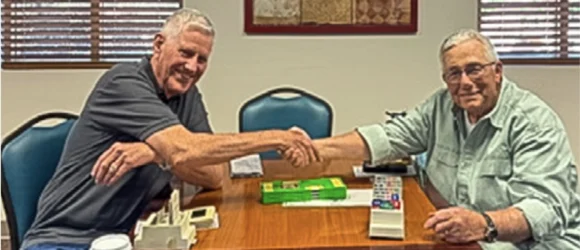
For the past eight years, Jim Malone and Dave Owens have been just that: partners. A steady pair. Familiar faces across the bridge table, exchanging the quiet language of bids and glances, triumphs and near-misses. To most at the club, theirs is simply a good match, nurtured by Joyce Potter, the partnership whisperer of the South Orange County Bridge Center in San Juan Capistrano.
Or perhaps, as some jokingly suggest, Joyce just liked the symmetry of a pair of “Jims.” (One, it turns out, is a nickname. You need to call him Dave.)
What no one at the club could have known in advance, not even, at first, the two Jims themselves, is that this partnership did not begin eight years ago. Its origins lie more than half a century earlier, in a place far removed from bidding boxes and scorecards.
Vietnam. Near Da Nang. 1968 to 1970. Marine squadrons H&MS 16 and Purple Fox Squadron - HMM 364.
They did not know each other then. Not really. Not beyond the anonymity of camouflage and the shared, unspoken understanding of young men sent into a war governed by forces far beyond their control. There were no leisurely conversations over beers, no easy camaraderie. Time there was measured differently: by missions, by moments, by survival.
J. “Dave” Owens remembers it now with the clarity, and the distance, of his eighty years. “Who is that man in the mirror?” he writes. “Some mornings, I recognize a familiar reflection; other mornings, I feel the need to reach out and shake a stranger’s hand.”
The years between then and now, he suggests, are both vivid and veiled—“hidden behind the trappings of camouflage… shrouded in an opaque haze.” And yet, the arc of his life stretches wide and full, a rearview mirror opening onto something unmistakable: a life well lived.
Before the war, there was another path entirely. A boy on the shores of Lake Carnegie, New Jersey. A student at Princeton. A future that pointed toward ministry, toward a life of study and contemplation.
“We must be willing to let go of the life we planned,” he reflects, “so we can live the life that is waiting for us.”
The awakening came abruptly—a letter from the Draft Board. A summons. A turning. What would a student of classical languages and theology know of war?
And yet, war became his calling, though not in the way first expected. The Army was not to be. Instead, Dave found himself drawn to the Marines, and to the cockpit. A Marine aviator. A different kind of ministry, perhaps; one measured in missions, in responsibility, in bringing men home alive.
He thought he might serve six years. Twenty-eight later, he was preparing to retire from a rewarding career with the Marine Corps.
His career would span two wars—Vietnam at the beginning, the Gulf War at the end—and more than 4,000 hours in the air, flying both rotor-wing and fixed-wing aircraft. In the cockpit, as young Marines boarded behind him, Dave would study their faces and offer a quiet prayer: Deliver us home in one piece.
From above, he watched the choreography of duty unfold. Behind him, a door gunner—Jim, or George, or Joe—stood ready at a .50 caliber machine gun, scanning the horizon.
Names were incidental. The mission was everything.
Jim Malone was one of those young Marines.
Unlike many young men of his generation, Jim did not wait to be drafted. While still in college, he volunteered for the Marine Corps. Rather than serving the minimum two years, he signed on for four, and then volunteered for Vietnam.
When his superiors discovered he could type, they assigned him to Group Headquarters (MAG 16) stationed at Marble Mountain, near Da Nang. But Jim wanted more than administrative duty.
“If I must be here,” he said, “I want to be proud of my contributions.” So, he volunteered again.
He stepped away from the relative safety of a desk and volunteered for any assignment that would get him off said desk: helicopter door gunner, retrieval of downed helicopters, scrounging for parts—literally ANYTHING.
And, without knowing it, the partnership of Jim and Dave began.
Fast forward nearly fifty years.
Now they sit across from one another at a bridge table, partners in a very different kind of game. The stakes are lower, the risks mercifully contained to overtricks and underbids. And yet, something of that earlier trust remains—the instinctive reliance, the quiet understanding that your partner will do his job.
They introduce themselves, as bridge players do. Jim will mention his years in the Marine Corps with characteristic understatement. Dave’s 28 years in uniform earn him quiet respect, though he often defers to another club member, Jack Rippy, whose three decades of service place him just ahead in the informal hierarchy of Marines.
But both men carried their discipline and curiosity into remarkably full lives after the war.
When Jim returned home, he resumed his studies at UCLA, initially immersing himself in Japanese Political History with an emphasis on the Tokugawa Period (1603–1867). He learned to speak and write Japanese before practicality intervened. Realizing academia might not provide a stable future, he shifted course once again and earned a degree in Accounting.
His first professional position was as a budget analyst for the City of Los Angeles. Later, he joined tBP Architecture in Newport Beach, where he spent twenty-five years as Chief Financial Officer.
Yet careers alone do not define Jim Malone.
For years, he was a nationally ranked chess player, competing seriously until 2000. When he could no longer find a local chess club, he turned his formidable analytical skills toward bridge instead, much to the benefit of his future partner.
He is also an adventurer in the truest sense of the word. Jim has hiked the legendary Inca Trail to Machu Picchu, climbed Mt. Whitney twice, and conquered the demanding ascent of Half Dome. The same determination that once led him to volunteer for Vietnam seems to echo through every chapter of his life.
Dave’s life, too, continued to widen after he stepped out of uniform.
A lifelong lover of poetry, he began to give language to memory—capturing life’s defining moments in verse. “From an early age, I have loved poetry,” he writes, almost as an aside, though it explains much. In recent years, that impulse has deepened, finding expression in advanced creative writing classes, fiction workshops, the slow and determined shaping of a first novel.
“The end of my opus is in sight,” he says, “if I can convince myself to stop rewriting each chapter.”
Even now, there is forward motion. Curiosity. Discipline. The same qualities that once carried him through thousands of hours in the air now guide him through pages, paragraphs, and the delicate architecture of story.
And somewhere in that story, written and unwritten alike, is Jim.
It is only now, with the luxury of hindsight, that the remarkable truth comes into focus.
More than fifty-seven years ago, in the chaos and uncertainty of Vietnam, they were already there—on the same missions, in the same aircraft, bound by the same fragile thread of survival.
They just didn’t know each other’s names. Today, they do.
Jim Malone and Dave Owens can look back through the long arc of their lives and recognize something extraordinary: that long before they ever shook hands across a bridge table, they had already trusted each other with their lives.
Call it fate. Call it the luck of the draw. Either way, it’s a partnership for the ages.
Special thanks to Joyce Potter and Janie Matlaf of the South Orange County Bridge Center for their indispensable help in writing this article. ♣